
From Engen to Møhlenpris – a journey with the museum tramway
Written by Jørn Ruud, 2025.
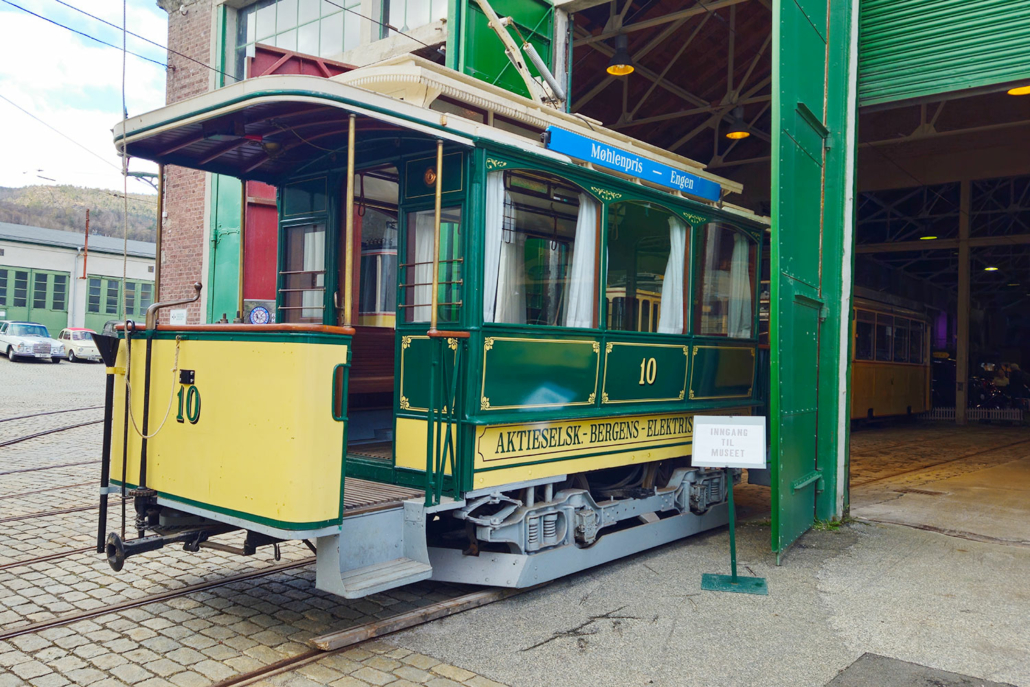
The Museum Tram is operated by the Bergen Electric Tram Association. The tram runs from the statue of playwright Henrik Ibsen in front of Den Nationale Scene and over Nygårdshøyden with the University area and a number of cultural institutions and attractions and to the old Bergen Sporvei carriage hall at Møhlenpris. The hall today houses the Bergen Technical Museum.
The Museum Tram follows the route of one of Bergen's four old tram lines, line 3, which opened in 1911. It ran from Møhlenpris to Dreggsallmenningen via Engen and Bryggen. Line 3 was special. With its steep and curving route, it was the closest we in Norway came to the spectacular and famous tramway in Lisbon. In the areas through which the Møhlenpris tramway ran, there are top-class sights in a row. Much of the buildings along the line will amaze architecture and art enthusiasts. A key question then becomes: Why did the area get an electric tramway, and why was the Møhlenpris tramway and later the rest of the tramway in Bergen closed? To answer this, it is necessary to give a brief overview of Bergen's urban development.
Bergen's topography and urban development in the 19th century
Central Bergen is sandwiched between seven mountains. In the west, Løvstakken, Damsgårdsfjellet and Lyderhorn are traditionally the encirclements of Bergen. Until well into the 19th century, the then sparsely populated Nygårdshøyden actually delimited the city to the west. Only then did urban development in Bergen begin to conquer this ridge. At the beginning of the 19th century, Bergen was in a period of stagnation. Around the middle of the century, the city came back to life and began to expand beyond its old borders. In 1801, Bergen had about 18,000 inhabitants. A hundred years later, about 78,000 people lived in Bergen, a formidable population growth. In 1865, Bergen Museum's new monumental building was completed at the top of Christiesgate and the city began to creep up Nygårdshøyden.
The new development was socially stratified. On lower Nygård, barracks-like "graybones estates" with small apartments for workers and other low-income groups were built. Further up Rosenbergsgaten, apartments of a higher standard were built for more affluent social classes. From Allégaten and up to the top of the hill, the very richest settled in large villas and in blocks with luxurious apartments.
Bergen is, and was not, socially divided into an east and west side like Oslo and many other cities. Among other things, the topography led to the different social classes living closer together. One of the exceptions was the upper parts of Nygårdshøyden which was dominated by the wealthy upper bourgeoisie.
On the west side of Nygårdshøyden, a completely new district, Møhlenpris, grew up before and around the turn of the last century. It became more than a suburb, almost a city within the city. Perhaps we should dare to call the district Bergen's first shantytown? During this period, Bergen also became an industrial city. Much of the new industry, including large shipyards, was built on the outskirts of Bergen such as Møhlenpris and in the then neighboring municipalities of Årstad and Laksevåg, which until 1915 were located in Askøy municipality.
As the city expanded, the need for efficient passenger transport grew. This became possible due to technical developments. Steam ferries were introduced on the Lungegårdsvannene lakes and steamboats to Sandviken. The first steam ferries to Laksevåg were put into operation in the 1880s, and when the Vossebanen Line opened in 1883, Solheimsviken got its own railway station, giving this important industrial suburb a modern connection to the city centre. Until 1913, the Vossebanen had an entrance to Bergen on a bridge over the Nygårdstrømmen, and a central station where Code 2 – The Art Museums of Bergen are located today.
The city's "big market" for groceries at the time was Torget and Kjøttbasaren. The specialty stores were also mostly located in the city center. It was both heavy and time-consuming for a housewife to lug consumer goods out to the new districts. Only the very richest had stables and their own horses, not to mention the newfangled automobiles that came to Bergen after the turn of the last century. The solution was another technical innovation, the electric streetcar, or tram as it was soon called.
The word "trikk" has a somewhat strange background. It originated in the vernacular and is a Norwegian abbreviation of the English word electric. This abbreviation is not tied to an electric vehicle on rails – For example, the ferries on Vågen – which were powered electrically from the start in 1894 – were called "Trikkefærgene" by the city's population.
Second city in the Nordic region with an electric tramway
In 1897, the new Bergen Electric Tramway opened its first tram lines. Bergen was actually the second city in the Nordic countries to get an electric tramway. Kristiania was the first in 1894, Copenhagen in 1899 and Trondheim and Stockholm in 1901. This, for its time, very modern means of transport also made daily work trips possible. In an era with working days of both 10 and 12 hours or more, people preferred to live as close to their workplace as possible. Fast and convenient transport to and from work by tram meant that workers could settle somewhat further from their workplace than previously. In other words, an easily accessible and reliable tramway with affordable fares became an important factor in urban development, something we are experiencing again today after the Bybanen came into operation.
The Møhlen Prize
As mentioned above, in 1911 Nygårdshøyden and Møhlenpris got their own tram line, line 3. Like all the tram lines in Bergen at the time, most of the line was single-track. It ran from Møhlenpris school and over the hill and Engen, and down to Torget. A few years later it was extended in front of Bryggen and had its terminus at Dreggsallmenningen. In this way, it connected Møhlenpris and Nygårdshøyden with the city's business center and all the local boats in the Vågsbunnen, which at the time were absolutely central to Bergen's connections with the surrounding area. The Torget and the quays along Vågen were the communication hubs in Bergen at the time.
At Møhlenpris, the line was fed from 1916 by the ferry "Uren" which connected the new industrial and residential areas west of Damsgårdssundet with the new tram line. Until 1950, the Uren was a small steam ferry that required a crew of three on the short stretch across the Damsgårdssundet. The opening of the Puddefjord Bridge in 1956 meant that the somewhat newer motor ferry "Uren I" had to give up the following year.
Bergens Elektriske Sporvei has reconstructed line 3 up to Engen and we have kept the single track, also because it helps to make the time travel more authentic. The streetscape and the street environment the tram runs through are almost unchanged from how it was when the line was closed in 1950.
With the museum and culture tram over Nygårdshøyden.
The museum tram is also a cultural tram. The tour begins at Engen by the statue of our great playwright Henrik Ibsen in front of the theater building of Den Nationale Scene, Thalia's temple in Bergen. Engen was previously the city's party place, the place where Bergen residents celebrated May 17th and where the Borgervæbningen, the home guard and reserve police of the time, paraded. The large open space disappeared when the theater building was completed in 1909.
The reason the tour starts here is because that was the point at which Bergens Elektriske Sporvei (BES) was granted permission to build the country's only museum tramway with its own concession. Originally, the line continued down to Torgalmenningen through the area that was destroyed by the great city fire of 1916, and from there on down Torget and beyond Bryggen. After the fire, the line was rerouted so that at the exit from Magnus Barfotsgate it went north and around the theater building and then down the newly built Christian Michelsens gate. The new zoning plan after the fire in 1916 created a new and modern city center designed for double-track tramways and pedestrians
Den Nationale Scene is the best example in Norway of a monumental building in Art Nouveau style. The architect was Einar Oscar Schou. The theatre was damaged in an air raid on Bergen harbour in 1940, but was later repaired, expanded and restored, most recently in 2001 when the theatre hall was restored to its original design. The building was listed in 1993.
One of Bergen's most eerie memories, the Gestapo Museum, is also located here in Veiten. Outside, there is a memorial stone to the victims who suffered in what was then a house of horrors.
Cinemagoers' paradise
Immediately after leaving the theatre, the museum tram's cultural journey continues when the tram enters Magnus Barfotsgate. Here we find the premises of Bergen Kino. On the left is Magnus Barfot Kino, a newly built and modern premises with six halls where films can be shown simultaneously. Just beyond in Neumansgate we find the Konsertpaleet with 12 cinema halls. Parts of this last cinema palace are located on the same site as Bergen's old theatre building, the Komediehuset på Engen, built in 1800. From 1851 to 1857, Henrik Ibsen was associated with this theatre and lived in an apartment in the building. The large wooden building and parts of the Nøstet district were destroyed on 29 October 1944 in an Allied bombing raid that was actually aimed at the German submarine base at Laksevåg. His time at the theatre in Bergen was the beginning of Ibsen's career as one of the world's foremost playwrights.
Bergen Kino organizes the Bergen International Film Festival (BIFF) every autumn. Measured in number of titles, this is Norway's largest film festival. It was first organized in 2000 when Bergen was the European Capital of Culture. Visitor numbers at BIFF have now reached more than 50,000 paying moviegoers.
Nygårdshøyden – from brick tenement houses to the residences of the upper class
The streets in this area are named after Norwegian medieval kings. In Magnus Barfots gate, the first brick tenement houses in Bergen were built in the 1880s. The houses are generally four stories high and inspired by continental models. Bergen and Kristiania are some of the few cities in Scandinavia that built entire uniform blocks of this type of building. The houses were intended for people with a more popular social status than those higher up along the tram line.
The medieval king Magnus Barefoot was the father of Øystein and Sigurd. He was probably given the nickname because he wore a kilt. It is often claimed, somewhat inaccurately, that the Viking Age ended when Harald Hardråde fell at the Battle of Stamford Bridge in England in 1066. King Magnus Barefoot was still a Viking and warrior king who conducted several campaigns in the British Isles where he tried to link the Isle of Man and the Southern Islands more closely to Norway. In 1103, Magnus was killed in Ireland.
At the top of Magnus Barfots gate, the tram takes a spectacular turn into Øisteinsgate. The stretch here is very steep. The street is named after Øistein Magnusson, who was the half-brother of, and co-king with Olav Magnusson and Sigurd Jorsalfar. Olav died early. Sigurd is best known for his Crusade to the Holy Land. He also has his Bergensgate in the same area, Sigurdsgate. The Crusades were the European medieval princes' international operations in the Middle East to protect the holy places of Christianity against the Muslims. While Sigurd was in the field abroad, the more peaceful Øystein stayed at home and built the country, mountain lodges for travelers on Dovre, harbors along the coast, and several church buildings. The Monastic Monastery in Bergen was founded by him.
On the upper side of Øisteins gate lies the towering and dominant Øisteinskvartalet, or the Nævdalske complex with its 100-meter-long facade from the 1890s. Master builder JH Nævdal commissioned architect Schak Bull to design this building complex with apartments for more affluent residents, but the complex was not completed according to the original plans. The magnificent original decorations of the roof have unfortunately been removed during later maintenance work.
The area around St. John's Church
At the top of Øisteinsgate, the tram crosses the square between Johanneskirken and Vestre Torvgate. On one side of the square, Johanneskirken literally reaches for the clouds. The neo-Gothic church is Bergen's tallest building. In 1888, Kristiania architect Herman Backer (1856-1932) won a competition to build the church. Backer, like many Norwegian architects at the time, was educated in Germany. Johanneskirken, with its high location, is a favorite destination for tourists who often mistakenly believe this is the city's cathedral. In any case, they have not gone in vain. The church has a beautiful interior and a carillon has been installed in the tower. The church has a quality organ and is often used for church concerts. Vestre Torvgate opens up here in Bergen's parallel to the Spanish Steps in Rome and the Primorsky Staircase in Odessa, which became world-famous from Soviet director Sergei Eisenstein's famous film about the armored cruiser "Potemkin". On one side of the stairs, at the top, is a large brick villa from the upper middle class era, and on the north side is a block of large and representative apartments from the same period. At the top of the stairs, visitors have a magnificent panorama of Bergen City Center.
Nygårdshøyden – Bergen's Victorian district
When the tram passes the top of the hill, we are in a part of Bergen that is full of sights and attractions that, strangely enough, have often been overlooked in the description of the city. This is the stronghold of academia, the core area of the University of Bergen, which has established itself here by changing the use of a large number of former homes and some new buildings. This is an area with many preserved buildings from the late 19th century when Bergen's upper class built their large, magnificent homes on Nygårdshøyden. Nygårdshøyden can be compared to the western edge of Kristiania and also has a number of public monumental buildings.
By the Johanneskirken is Sydneshaugen, which once belonged to the Fastings Minde pleasure ground. The old wooden building still towers over a knoll with a view of both the city and the Byfjord. Acquiring pleasure grounds was a status symbol among wealthy Bergen citizens between 1750 and 1850. They were often surrounded by idyllic gardens, often with an associated farm. Here, the owners could cultivate sociability in the summer and enjoy the joys of country life. The lack of communications at the time meant that pleasure grounds were often built close to the city. The place was owned by the writer and musician Claus Fasting (1746-1791).
Before the Museum was built, Sydneshaugen was an open-air area for the city and the site of St. Hans celebrations, ice skating on Rakkerdammen and other activities. There was a riding arena on the grounds of St. John's Church. The "home guard" of the time, the Borgervæbningen, held exercises here. On the grounds of Fastings Minde, you can today find the main building of the University Library, which was inaugurated by King Olav in 1961. The executive architects were Kåre Kvilhaug and Jo Svare, and the building was made possible by a gift from JL Mowinckel's shipping company as a memory of the shipowner and prime minister of the same name. The University Library (UB) is one of the country's largest academic and research libraries.
Maritime Museum and Sydneshaugen School
Behind the University Library and next door to the Historical Museum is the Bergen Maritime Museum building, which was completed in 1962. Some may find it strange that a maritime museum is located on a hill a good distance from the sea and harbor. But when you enter and see the exhibitions of ship models, figureheads, ship paintings and other maritime memorabilia from earlier times, you forget the location. This award-winning building, designed by architect Per Grieg, is also the result of private donations from the shipping company Westfal-Larsen & Co.
Right next to St. John's Church is Sydneshaugen School, which is currently run by the University's Faculty of Humanities. The former middle school and high school, designed by city architect Kaspar Hassel (1877–1962), were completed in 1921. The enclosed structure is typical of school buildings of its time. But the building is both stylish and practically furnished. On the second floor is a memorial to teachers and students at the school who lost their lives during World War II.
Within a few years, Bergen Municipality, in addition to this school, also built the very modern and expensive Nygård and Nykrohnborg schools for their time. The fact that this promise could be afforded at the time testifies to an admirable political prioritization.
From Johanneskirken, the veteran tram continues through Langes gate and crosses Olav Kyrresgate, which, like the other streets up towards Nygårdshøyden, is reminiscent of the steep streets in San Francisco. Langes gate is named after the historian Christian Lange, who took over as national archivist from Henrik Wergeland. Thanks to him, much old Norwegian archival material was returned to Norway from Denmark.
The University's Great Hall – the old museum
The tram crosses Muséplassen in front of the stately and monumental old main building of Bergen Museum. Bergen Museum, founded in 1825, is the forerunner of today's University, which was established by a parliamentary resolution in 1946.
The museum building from 1865 in the neo-romantic style was designed by the Danish architect Johan Henrik Nebelong, who is also the creator of the royal pleasure palace Oscarshall on Bygdøy in Oslo. The two side wings were not completed until the late 1890s. Above the entrance portal is a sandstone Minerva head. Below all the windows are lion heads that were designed by students and teachers at the Bergen School of Drawing.
The museum site is the origin of the university's academic world. The museum towers at the top of Christiesgate and has a dominant position in relation to the city that can be compared to the Royal Palace in Oslo. While in front of the palace there is an equestrian statue of the Union King Karl Johan, in front of the museum there is a statue of the museum's founder, the strongly interested in cultural history and archaeology Wilhelm Friman Koren Christie (1778 – 1849), who looks out over his city.
Christie founded the Bergen Museum in 1825. He was born in Kristiansund and came to Bergen at the age of 11. Like many other civil servants, he came from a family with foreign roots. The family originated in Scotland. After Latin school, he studied in Copenhagen and became a lawyer. He was secretary of the constitutional assembly at Eidsvold in 1814. In the autumn of the same year, he was elected from Bergen to the extraordinary Storting, which, after the conclusion of the Moss Convention, was to settle the union relations with Sweden. Christie was elected president of this Storting and was central to the union negotiations that resulted in the Eidsvold Constitution not being changed more than strictly necessary, before the Storting finally elected Carl XIII of Sweden as Norwegian king. Paradoxically, Christie was elected from Bergen with a binding mandate to vote against union with Sweden and thus the preparatory work for union that he led. Later in life, Christie first became a county magistrate (county magistrate) and then a customs inspector in Bergen.
By a parliamentary resolution in 1946, Bergen Museum became part of the University of Bergen, Norway's second university, and it is the only university in Norway that still has its campus centrally located in the city.
The museum square continues down towards the city on Christies gate. At the top of the square, the street is elegantly flanked by the magnificent villas of businessman Christian Sundt (1816-1901) and Kristofer Lehmkuhl (1855-1949). The gigantic villa of merchant Sundt in the neo-Renaissance style was built in 1881 with Edvard Madsen as architect. Sundt was at one time the richest person in Bergen. He was a "self-made man" who worked his way up from humble beginnings with great skill. The building now houses the University's rector and top management. From 1936 to 1963, the Norwegian School of Economics (NHH) was located here. Behind the Sundt villa was the schoolyard of Ulrike Pihl's girls' school. One of the early students at NHH was the author Agnar Mykle. His book "Sangen om den røde rubin" from 1956 with its frank erotic depictions was the sensation of the fifties and a major scandal in Norway. After a harrowing trial, Mykle and Gyldendal publishers were finally acquitted by the Supreme Court in 1957. In the novel, Mykle writes about economics student Ask Burlefot who observes all the young girls in the schoolyard at the nearby U. Pihls girls' school. Mykle's own time studying at NHH was the inspiration and backdrop for the book. Many in Bergen were offended by Mykle because they believed they could recognize themselves in the book's gallery of characters.
On the other side of the street is Kristofer Lehmkuhl's villa, also built in 1881 with Johan Faye as architect. From 1912 to 1937, Lehmkuhl was director of Det Bergenske Dampskibsselskab, the very jewel in the crown of Bergen's shipping companies. It is not unnatural that the villa, which is in the neo-Renaissance style, is adorned with a characteristic statue of the sea god Neptune with a pitchfork in his hand. The building's exterior is reminiscent of a miniature Louvre. Today, both the Lehmkuhl villa and the other buildings on this side of Christiesgate are used by the University's Faculty of Social Sciences.
Kristofer Lehmkuhl was also a merchant and politician. From 1905 to 1907 he was Minister of Labor in Christian Michelsen's government. Lehmkuhl was a driving force behind the establishment of the Norwegian School of Economics in Bergen. He was also the initiator of the acquisition of a new school ship for Bergen. The barque "Statsraad Lehmkuhl" is named after him.
The manufacturer Sundt also had great cultural and scientific interests. When Bergen Museum was established in 1825, the statutes stated that the museum should also conduct research. Sundt's fund for the advancement of Bergen Museum made it possible in 1911 to raise the salaries of the department directors to professor level.
One of Bergen Museum's researchers was Fridtjof Nansen, who lived in Bergen in the 1880s. It was here that he carried out the research that later led to his doctoral thesis in neuroanatomy.
Both Sundt and Lehmkuhl are good examples of how many of the city's wealthiest people were socially engaged patrons who generously gave money to socially beneficial causes.
The large Museum building from 1865 has now been renovated and today houses the University auditorium and the University Museum's natural history collections in zoology, botany and geology. The hall with the large collection of whale skeletons is unique in the world. Parts of the exhibitions are also a museum of museums because many objects are still in the original display cases from the second half of the 18th century. Many Bergen residents have experienced the museum's collections of stuffed exotic animals as a breath of fresh air from the big world in their childhood. The museum has been a favorite destination for families with children on rainy Sundays.
The Museum Garden
Around the old museum building, the 14-acre Museum Garden was laid out in 1896 to 1897. It has approximately 3,000 different plants. It was the University's research garden until 1996 when this function was added to a new and larger botanical garden near the arboretum at Milde. In the 1930s, the Museum Garden was given its current design with paved walkways and ponds. The water basins in front of the soapstone arches in the museum's south wing date from this time. The garden with the large greenhouse from 1900 was listed in 2013. The greenhouse was a gift from Consul Conrad Mohr and was for many now elderly Bergen residents the place where in childhood they could see real tropical fruits such as bananas growing in the greenhouse's steaming "jungle".
Inside the museum garden stands a bust of Bergen physician and researcher Armauer Hansen, who in 1873 discovered that leprosy was an infectious disease and was caused by a bacterium. This was the first time in history that a disease-causing bacterium was detected and is the biggest event in the history of Norwegian medical science. Bergen was a center for research into this terrible disease. While leprosy had largely disappeared elsewhere in Europe in the 19th century, it was still a scourge in the coastal areas of Western Norway and further north. Hansen's discovery led to Norway introducing laws to prevent the spread of the infection, laws that later became a model for other countries. One example is Japan. The last Norwegian leper died as recently as 2002. Another name for leprosy, or leprosy, is Hansen's disease. No other Norwegian person has been depicted on as many stamps around the world as he. After Armauer Hansen's death in 1912, the urn with his ashes was placed under the pedestal of the bust in Musehagen.
The beautiful garden with its exotic plants and trees is a favorite place for students and others on sunny days. Few visitors are aware that the area where the museum and garden are located today was formerly known as Rakkerhaugen. A rakker (nightman) was a low-status occupation who performed renovation work and was also the executioner's assistant. Rakkerhaugen was one of Bergen's execution sites until 1803. Then Anders Lysne was the last to be beheaded here. He was sentenced to life imprisonment, as it was called at the time, because he protested against the fact that the Lærdøls should serve military service. For the rest of the century, the executioner took the axe and the condemned to the old execution site at Nordnes when criminals were to be executed.
The very last was the convicted murderer Jacob Wallin, who on January 25, 1876, had to publicly climb the scaffold that had been erected on the old playground (!) at Nordnes.
Historical museum
On the west side of the botanical garden is the building for the University Museum's cultural history collections in archaeology, cultural history, art history and ethnography. In these areas, the museum owns one of the country's largest collections. In everyday speech, the building is often called the Historical Museum. The house has a towering tower, but otherwise seems a bit secluded from its surroundings. It is a shame because it is a magnificent building. Professor Per Jonas Nordhagen calls the building, with its solid materials and outstanding craftsmanship, one of the most beautiful museum buildings in the Nordic region, both outside and inside. Architect Egill Reimers (1878-1946) designed the building in collaboration with archaeologist Haakon Shetelig and art historian Einar Lexow. The museum, which was completed in 1927, resembles a castle, but is very practically furnished so that it has only now (2025) been necessary to rebuild it. The museum's collections of old church art are also unique in an international context.
From Langes gate, the tram turns into Olaf Ryes vei, which is named after Major General Olaf Rye (1791 – 1849). Rye was one of the heroes of the first Danish-Prussian war (1848 – 1851) for power in the duchies of Schleswig and Holstein. He fell in the Battle of Fredericia. Like Major General Friderich Adolph Schleppegrell who fell at Flensburg and Colonel Hans Helgesen, Rye was born in Norway, but chose to remain in Danish service after 1814. “The Three Norwegian Spruces” as the officers were called, became heroes in both Denmark and Norway for their efforts in this bitter war. Before Rye left Norway, he also set an unofficial world record in ski jumping.
The tram then runs up along the University Student Center and crosses Parkveien. Parkveien is perhaps the city's most distinctive street. It is named after the beautiful Nygårdsparken into which it opens. Nygårdsparken is Bergen's "Central Park" and was formed as a private park company in 1880. The shareholders received a return on their investments when the company sold plots of land on the park's outskirts. The park, with its planting and swan ponds, blends almost imperceptibly into the buildings on Parkveien. On the west side of the street, Villaveien 9 still stands, one of the city's largest and most beautiful neo-Renaissance buildings. The other old villas here were demolished to make way for the Student Center. East of the street, Bergen's best preserved examples of a row of houses with large patrician apartments from the 1880s are located. The buildings have an almost symbolic small front garden that was probably intended to give associations with country life. The richly decorated facades have brick verandas, not suspended cast iron balconies that were otherwise becoming common at this time. The architects, with Schak-Bull at the helm, were inspired by various historical styles and in the buildings you can trace, for example, both classicism and neo-renaissance. The streetscape is unique in Norway and is reminiscent of Victorian environments on the west side of London.
We then cross Villaveien, which rightly bears its name. The buildings that line the street are magnificent villas, both in brick and wood, from the late 19th century. They are highlights of Bergen's upper-class architecture. Several of them have now been taken over by the University. Some of the villas were designed by architect Schak Bull. In the area we also find the Human Rights Square with the Rafto Foundation, which is named after the professor and human rights activist Thorolf Rafto. In his memory, the prestigious Rafto Prize is awarded annually to people from disadvantaged areas of the world who fight for human rights and democracy. Several of the prize winners have later received the Nobel Peace Prize.
Møhlenpris – Art Nouveau Town – Bergen's first shack town.
At Villaveien we pass the top of Olaf Ryes vei and drive down towards Møhlenpris.
The district is named after the German Jørgen Thormøhlen (1640 – 1709) from Hamburg. He became a citizen of Bergen in 1664 and established himself as an entrepreneur, merchant, shipowner and industrial builder. In 1695 he received permission from the king to issue the first banknotes in Denmark/Norway. Here in the district that later received his name, he built a ropeway, soap factory, saltworks and a trance distillery. Later things went badly for him. After the great city fire in 1702, he was well on the way to bankruptcy and traveled to Copenhagen. He was insolvent when he died in 1709.
To the north, Møhlenpris passes into Dokken and Jekteviken, a former rural area with Bredalsgården as the main landowner. The name Dokken probably comes from the fact that the area was a storage area in the sailing ship era and that ships were also built here. In 1908, the city's gasworks was moved here from the area where the railway station is located today. During the interwar period, Dokkeskjærkaien was built. Today, Dokken is characterized by post-war apartment blocks and the large container port. But there are still some large villas from a bygone era in this area. For example, the Gasworks' old administration building at Jekteviksbakken 6, which is now a mosque. The house was originally the main building of a Bergen pleasure resort that was located here.
The modern Møhlenpris began to grow at the end of the 18th century and became almost a separate community with large industrial workplaces such as Mjellem and Karlsen's mechanical workshop and new residential quarters with apartments for both the less well-off and the rich. In the same area, buildings were erected with simple homes for workers and lower-income employees, exemplified by "Trikkebyen", and more expensive apartments for the better-off in Welhavensgate. The district has survived both brutal renovations such as when the Puddefjordsbroen bridge was expanded and the closure of industrial and workshop companies. Approximately 160 apartments were renovated to make room for the new Møhlenpris intersection. Nevertheless, today the district appears as an attractive residential area with cafes and a distinctive atmosphere. A footbridge has been built that connects Møhlenpris with the new and modern residential areas and office blocks that have grown up on the old industrial sites in Solheimsviken and under Løvstakken west of Damsgårdssundet.
At the bottom of Olaf Ryes vei, the tram passes Hulen, the Bergen Students' Club, which opened in 1969 in the large shelter that the Civil Defense had built here. Some must have breathed a sigh of relief that the radical students of the 1968 generation were given this activity center. They probably hoped that the students would express themselves there in their free time instead of running around the streets demanding revolution. It was not without reason that Nygårdshøyden was at this time colloquially known as "Leninhøyden".
After a sharp turn to the right we are in Wolffsgate, which is named after the poet-priest from Snåsa, Simon Olaus Wolff (1796 – 1859), who is particularly known for the poems “How wonderful is my homeland” and “The North Sea”. Next to Wolffsgate is Møhlenpris sports field. When it opened in 1899, it was Bergen’s first modern sports arena. Møhlenpris playground, as it was called, was Bergen’s stadium for football matches and other sporting events for a long time. Ice skating was held in the winter. Here in February 1940, Aage Johansen set an unofficial world record for 5000 meters with a time of 8:14.8. A time that says a lot about how ice skating has developed since then. When the thermometer in winter crept below 0 degrees, the field was iced over and opened to anyone who wanted to go ice skating. Older Bergen residents fondly remember the good atmosphere and social life at this ice skating arena.
During the warmer months, both children and adults flocked to the annual Fire Department Day, with demonstrations of firefighting equipment, jumping in fire ropes and using fire ropes from the top of the tallest ladder truck. The event was rounded off by extinguishing a fire in a small house that had been built for the occasion.
For 40 years, football blitz tournaments were held at "Møllaren", as the pitch was popularly known. The weekend blitz tournaments with their short rounds kicked off the football season in Bergen and took place at the end of March or the beginning of April.
The tram then turns into Thormøhlens gate along Møhlenpris school, which was completed in 1912. Further down this street was formerly the busy Mjellem and Karlsen mechanical workshop. One of the old halls of the shipyard today houses the new Corner Theatre, which is a gathering place for the independent performing arts in Bergen. The shipyard bordered Marineholmen, where the Western Norwegian Navy was based from 1818 until the Haakonsvern naval base was put into use in 1962. The area is today home to, among other things, the VilVite Center, which is a popular science experience and learning center for technology, natural sciences and the sciences. Here we also find Bergen's Constitution Monument, which was unveiled at the 200th anniversary of the Norwegian Constitution in 2014. The monument stands on Christian Frederiks plass, named after the Danish prince who was elected King of Norway at Eidsvold in 1814 and who has much of the credit for Sweden's acceptance at the Convention in Moss that Norway could retain its new constitution in union with Sweden.
In 1913, the tramway moved into the new Møhlenpris wagon hall, which remained the tram's main depot until its closure on New Year's Eve 1965. The hall is built of brick and the architect was Schak Bull (1858 - 1956). The building is a unique example of how people at that time did not only think functionally and practically. Inside, it seems enormous. Outside, it may seem more modest at first glance. If you study it more closely, you will discover the fine details. The aesthetic was emphasized even in a wagon hall and workshop building. The hall, which is adorned with three towers with spires and a copper roof, appears almost like a cathedral for progress and the new technological age represented by electricity and trams. The hall, which is in Art Nouveau style, became a landmark in Møhlenpris, which has many buildings from this style era. The architect Schak Bull was a Bergen representative of Art Nouveau. The tram hall was protected by the National Agency for Cultural Heritage in 1994.
The hall currently houses the Bergen Technical Museum, a voluntary association of various associations that store their collections in the building. Bergens Elektriske Sporvei continues the building's traditions by exhibiting its trams, trolleybuses and other material.
The rise and fall of Bergen knitwear
As mentioned, Bergen was an early adopter of electric tramways. On June 28, 1895, the plans were approved by the city council. The operation of the new tramway was entrusted to Aktieselskabet Bergens Elektriske Sporvei, which was founded in 1895 in Berlin. The majority of the shares were owned by the German company Union Elektricitäts Gesellschaft (UEG), which also built the facility. Construction work began in the autumn of the following year and operations opened on June 29, 1897. The contrast to today's lengthy planning processes for similar facilities is enormous. The gauge was 1435 mm, the so-called standard gauge, which is also used on all of Jernbanerverket's lines in Norway today. The gauge dates back to 1825 when the British engineer and locomotive designer George Stephenson standardized this gauge for all of his railway facilities. It is the most widespread in the world for both railways and tramways.
There were some changes to the lines in the early years, but eventually four lines emerged. Line 1 ran from Minde to Sandviken, Line 2 from Engen to Fridalen, Line 3 from Møhlenpris to Dreggsallmenningen and Line 4 from Sentrum to Nordnes. In 1917, the tramway passed into Norwegian ownership when shipowner Haakon Wallem bought the German shares. The following year, Bergen Municipality took over construction and operation.
The tram in Bergen never gained the foothold that the tramways in Oslo and Trondheim had. By around 1930, the line network had already reached its maximum extent and no new lines were built. The last new carriage purchases were made in 1947. In the 1920s, the tram in Bergen received a challenger in the omnibus, or bus as it was later called. As early as 1928, the political environment began to talk about trolleybus operation as an alternative to tram operation.
Until then, the tram held its ground, but no new lines were built beyond minor extensions of the existing network. When World War II broke out, the tram experienced an enormous increase in traffic. Oil, gasoline and rubber tires became scarce and the electric tram became almost the only means of local public transport. Bergens Sporvei suffered throughout its existence from a lack of carriage hall spaces. In the 1930s, a number of older carriages were scrapped, which now had its consequences. New material was impossible to order. In 1941, a carriage from 1909, the so-called "Oslo Princess", was taken over from Oslo Sporveier. In 1944, Sporveien had to send three motor cars and a trailer to Germany. The carriage shortage now became acute and line 4 to Nordnes over Klosteret was discontinued and never put into operation again.
Line 3 The Møhlenpris tram was closed in 1950 and replaced by a trolleybus line that is now also closed. It ran via Nøstet and continued to Mulen. The trolley hall at Møhlenpris then only had a connection to the tram network via a track to Florida. However, the tramway management still wanted to invest in trams by extending lines 1 and 2 in both directions, but the idea was abandoned. In December 1957, line 2 was converted to trolleybuses. In 1959, the broadly composed tramway committee in Bergen submitted its recommendation that concluded with discontinuing tram operations. In the autumn of 1960, the Storting decided to abolish the car rationing from the war years and politicians concentrated more and more on facilitating personal transport by private car. The following year, line 1 was shortened by closing the section from Sentrum to Sandviken. On New Year's Eve 1965, it was over and the operation of the Engen to Minde section was suspended. Many at the time probably thought that this was progress. The car was the future and the tram was in the way of this development.
The idea that rubber wheels should replace rails and steel wheels did not only affect the tram. In 1965, local railway traffic on the Bergen to Nesttun route was also suspended. A few years later, the rails on the route were removed.
Light rail
Even though the old city tram was gone, the discussion about continuing rail-based public transport soon flared up again. In the years that followed the closure of the tram, several proposals for rail-based suburban railways were put on the table. After excruciating political battles, it was finally decided to build a light rail south to Nesttun from Bergen city centre. The construction began in 2008 and the first section to Nesttun was opened by Her Majesty the Queen in 2010. Unlike the old city tram, the light rail is a suburban tram on its own route, but from Byparken to Wergeland it mostly runs on its own priority streets. Many of these streets up to Wergeland were previously served by the old tram line 1. In 2022, line 2 opened to Fyllingsdalen.
Bergen's electric tramway and the museum tram.
After the closure, all the old equipment, with the exception of carriage no. 10 from 1897, was cut up. In 1994, the Bergen Electric Tramway (BES) association was formed to try to restore museum operation with trams at Møhlenpris. Car no. 10 was restored with the help of funds from students at the Norwegian School of Economics (NHH). The work was carried out by Bergen Sporvei, which had now become a purely bus company. To strengthen the fleet, three motor cars and three trailers were purchased from East Berlin in 1996 for 1 DMark each. A motor car from 1913, no. 47, with a great resemblance to the old Bergen trams was brought over from Oslo. Work car no. 150 also came from Oslo. It was built in 1958 on a chassis and with electrical equipment from 1913.
The line from Møhlenpris to Engen, which BES has been granted a license to operate, took many years to complete, partly because the association was only allowed to lay rails when the municipality was digging in the streets. The most important individual in the volunteer work to establish the museum line has been Atle Ingebrigtsen. He was originally an electrical engineer for the trolleybus operation of Bergen Sporvei. He later moved to a similar position at Bybanen A/S.
To secure ownership of carriage no. 10 and the other carriage equipment, a foundation has been established called the Bergen Electric Tramway Foundation.
Sources
- Aspenberg, Nils Carl. From Minde to Sandviken: the story of the trams in Bergen – Oslo, 1996. – 146 p.
- Fossen, Anders Bjarne. The Lord of the Møhlen Prize: "So great was my happiness, so deep is my sorrow" About: Jørgen Thormøhlen -[Erdal], 2003. – 217 p.
- Leif Chr. Pedersen, Johanna Bugge Olsen, Per Slinde. Fifty years on the track: Bergen's tramway 1897-1947 . – Bergen, 1947. – 63 p. : ill.
- Gjesdal, Carl O. The city university on the mountain: a strolling journey from Florida to Dragon Mountain – Bergen, 1982. – 201 p.
- Hartvedt, Gunnar Hagen. Bergen city encyclopedia – 2nd ed. – Oslo, 2008. -525 p.
- Nordhagen, Per Jonas. On the University's Grounds: The Architectural History of Nygårdshøyden 1860-2000 – Bergen, 2004. – 208 p.
- Rue, Mai Linn. Møhlenpris – caught between hard and soft values: a study of planning and participation in the city centre district – Bergen, 1998. – V, 132 p. : ill. Main thesis in geography – University of Bergen, 1998 II.
- Tschudi-Madsen, Stephan. An anniversary wish for Bergen: The past and future of Nygårdshøyden – Bergen, 1970. – 30 p.
- Tveitnes, Åse. Getting to know the university: buildings – Bergen, 2011. – 132 p.
- Øfstegaard, Egil. From pasture to university: Nygårdshøyden in Bergen – Bergen, 1976. – 31 p.